
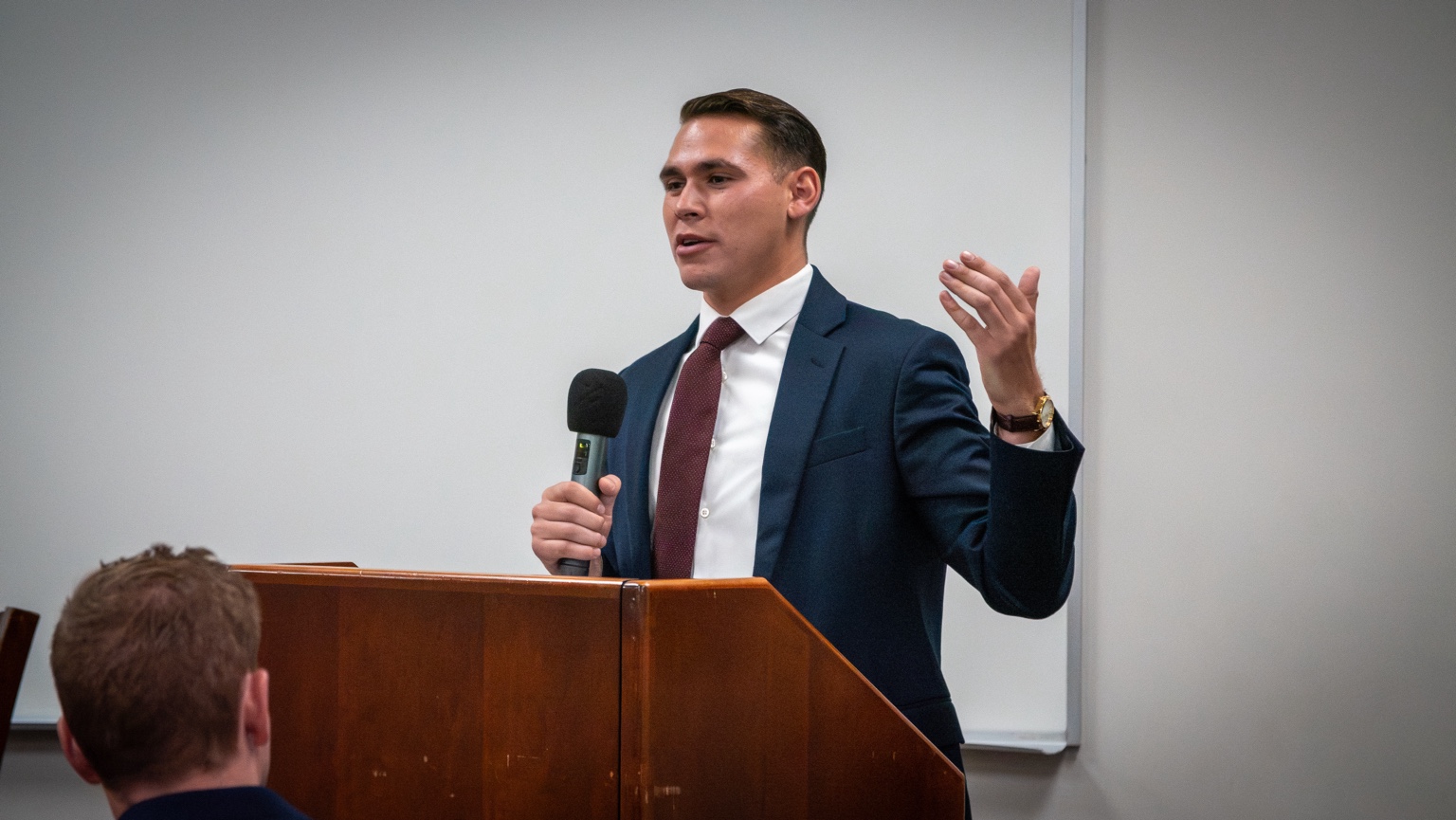
As delivered
Good evening, everyone, and welcome to the inaugural gathering of the Utah Emerging Leaders Forum.
I am privileged to be able to serve as UELF’s president and founder.
Thank you to Senator Todd Weiler and Councilman Carlos Moreno for joining us, to our team for making this evening possible, and to each of you for being here at the beginning.
What kind of people do we want to lead us?
We spend a great deal of time debating which party should govern, which policies should prevail, and which candidates should win. Those questions matter.
But before we entrust someone with responsibility, we ought to ask: Are they honest? Are they capable? Do they keep their word? Can they acknowledge when they are wrong? And when their personal interests conflict with the interests of the people they serve, which will they choose?
I founded UELF because I believe those questions deserve greater weight—and because we have a responsibility to become the kind of leaders we wish we had.
Like many of you, I am tired of seeing incompetence excused, dishonesty defended, and public responsibility treated as an opportunity for personal advancement. I am tired of petty partisan fighting and finger-pointing while problems remain unresolved. We need leaders willing to take responsibility, work across the aisle, and recognize a good idea regardless of who offers it. Too often, we lower our standards simply because someone is on our side.
Yet frustration alone will accomplish very little. If we want better leadership, we must help develop it. We must find capable people, bring them together, and prepare them to serve.
That is why we are here.
The Utah Emerging Leaders Forum brings together aspiring and established leaders across professions, backgrounds, and political persuasions. Our work rests on three practical foundations: leadership development, meaningful connections, and community service.
Through education, keynote discussions, mentorship, and service, we hope to help people develop both the ability to lead and the character to lead well.
A lesson in independent judgment
An episode from American history illustrates why that matters.
The election of 1800 left Thomas Jefferson and Aaron Burr tied in the Electoral College, placing the decision before the House of Representatives.
Alexander Hamilton had spent years opposing Jefferson. Yet he urged his fellow Federalists to prefer Jefferson over Burr.
This was no sudden friendship. Hamilton remained deeply critical of Jefferson, and his reasoning included political calculations. But he feared Burr’s ambition and believed it lacked the restraint of firm principles. Despite his disagreements with Jefferson, he considered him the safer choice.
The lesson I draw from that moment is that political allegiance must never replace independent judgment. We must remain willing to examine the character of those seeking power—even when doing so complicates our own political loyalties. We must be able to recognize the difference between someone whose convictions we oppose and someone whose conduct makes them unworthy of trust.
Our standards must apply to our friends as readily as to our opponents.
Imagine how much healthier our public life would be if leaders across the political spectrum were honest, capable, accountable, and sincerely committed to the people they serve.
We would still disagree. Good people can reach different conclusions about difficult questions. But we could disagree with greater confidence in one another’s intentions.
After an election, we ought to be able to look across the aisle and say, “All right. Fair enough. I wanted a different result, but I respect this person’s integrity. I will hold them accountable, and I will give them a fair hearing.”
That requires leaders worthy of such confidence, and citizens willing to extend it.
This is why UELF is nonpartisan. We welcome people with firm convictions who are also willing to listen, recognize a sound argument, and treat others with dignity.
We are not interested in building an army of pundits or partisan ideologues. There are already plenty of people prepared to explain what everyone else ought to do.
We are interested in finding and developing true leaders. We are seeking the Diamonds in the Rough: people of substance whose gifts may not yet have been recognized. People with the judgment to carry responsibility and the humility to keep learning.
To borrow an image from the military, we hope to help develop a corps of officers and future community leaders—people who lead by example, with integrity, courage, and humility.
Some may become elected officials or statesmen. Others will lead businesses, schools, charities, congregations, or families. Every one of those places needs people of integrity, courage, and sound judgment.
My experience in the Marine Corps has reinforced a simple conviction: when people depend upon you, your preparation, judgment, and example have consequences. Those entrusted to your care deserve both your concern and your competence.
That is the spirit of servant leadership.
The people entrusted to your care deserve both your concern and your competence.
Four standards of leadership
- Character before achievement. Success deserves respect, but a résumé cannot answer every question about a person. Integrity, honesty, courage, humility, discipline, and accountability should be prerequisites for leadership.
- Judgment before ambition. We don’t discourage ambition here. Ambition can accomplish great things when it is guided well. However, we must learn to weigh competing interests, understand consequences, exercise restraint, and distinguish what is popular from what is right.
- Service before self. Authority carries an obligation to others. Those who seek it should be prepared to place the welfare of their communities above their own convenience or advancement.
- Statesmanship before partisanship. That means preserving the ability to deliberate across differences, respecting the institutions entrusted to us, and making principled decisions even when our own side would prefer otherwise.
These are demanding expectations. Those who seek public trust should strive to conduct themselves above reproach while recognizing that all of us will sometimes fall short. When we do, integrity requires an honest acknowledgment, a correction, and the willingness to make amends.
These are standards we must live and practice ourselves.
Leadership is a lifelong practice of learning and self-correction. An invitation, an award, or a position may recognize potential. What we do afterward determines whether that confidence was deserved.
UELF should help people continue that work.
From conversation to contribution
We also want to open doors. In life it is often about who you know. Too often, opportunities circulate within familiar circles. Someone may possess talent and a willingness to serve while lacking the introduction that would allow them to begin. We want capable people to find mentors, meet one another, and discover where they can contribute. And we want those connections to produce something useful for our communities.
That means moving from conversation to contribution: identifying a need, organizing a project, bringing people together, and seeing the work through.
Service gives us a place to practice the qualities we discuss. It tests our reliability, teaches us to work with others, and reminds us whom leadership is meant to benefit.
We are the “Founding Fathers” and framers of our time. It is you. It is me. It is the people we know.
We are shaping the institutions, expectations, and civic habits that others will inherit. The conduct we reward becomes an example. The organizations we build become opportunities. The responsibilities we neglect become someone else’s burden.
It is up to us to rise above the pettiness and squabbles of our time and undertake work worthy of the future we hope to leave behind.
That work begins close to home—in our neighborhoods, schools, workplaces, and local communities. A new age of civic leadership will depend upon people who faithfully discharge the responsibilities already within their reach.
My hope is that, years from now, we will be able to point to people who met through this forum and went on to serve with distinction—people who became better prepared, more trustworthy, and more generous with their abilities because they were challenged here.
Tonight is a beginning. I hope you will meet someone you do not know, ask a thoughtful question, and consider what you might bring to this work.
We are grateful to have two guests whose experiences can help us examine these questions more closely. I look forward to discussing what has shaped their leadership, what public service has taught them, and what counsel they would offer those preparing to serve.
Thank you for being here, and welcome to the Utah Emerging Leaders Forum.